Warehouse Structural Design is not only about selecting steel frames or RCC members. For warehouses in Dubai and across the UAE, the structure must safely support storage loads, equipment, racking systems, forklifts, wind effects, roof services, future expansion, and authority approval requirements. A well-prepared design also helps contractors avoid redesign, site delays, unsafe modifications, and permit rejection.
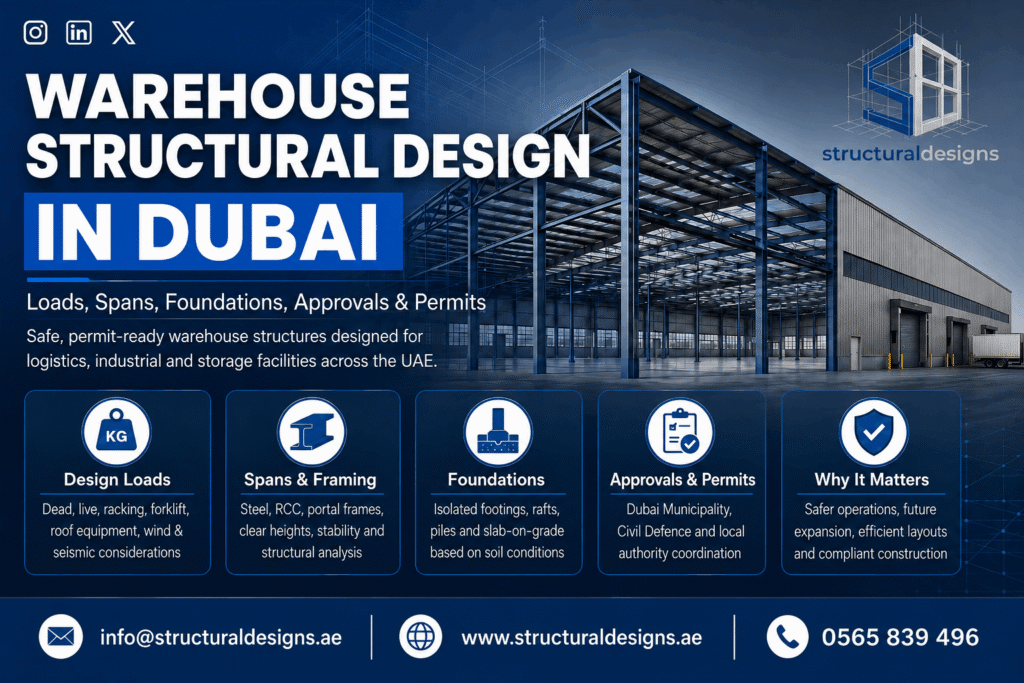
This guide explains the key engineering considerations for warehouse structural design in Dubai, Sharjah, Ajman, Abu Dhabi, Ras Al Khaimah, Fujairah, and Umm Al Quwain.
What Is Warehouse Structural Design?
Warehouse Structural Design is the engineering process of designing the load-bearing system of a warehouse, including foundations, columns, beams, roof frames, slabs, bracing, connections, and stability systems. It ensures the building can safely carry storage, equipment, wind, seismic, service, and operational loads.
A warehouse may look simple, but its structural behaviour can be complex. The design must consider clear internal space, high roof levels, heavy floor use, racking layout, truck access, loading bays, mezzanines, cranes, solar panels, MEP equipment, fire systems, and future business changes.
Why Structural Design Matters for Warehouses
Warehouse structures are often used more heavily than originally planned. A storage area may later receive pallet racks, cold room equipment, mezzanine offices, conveyor systems, or heavier forklifts. Without proper structural calculations, these changes can overload slabs, foundations, columns, or roof members.
Good structural engineering helps to:
- Provide safe load transfer from roof and floor loads to foundations.
- Reduce excessive deflection, vibration, cracking, and settlement.
- Coordinate clear heights and spans with logistics operations.
- Support authority approval and permit submissions.
- Avoid costly strengthening after construction.
- Allow future expansion where required.
Dubai Municipality states that the Dubai Building Code aims to unify building design and mandate minimum requirements across Dubai, so warehouse design must be coordinated with the current local code and authority expectations.
Key Loads Considered in Warehouse Structural Design
A reliable structural design starts with accurate loading. The engineer should not assume generic values without checking the warehouse use, storage system, material type, equipment layout, and authority requirements.
| Load Type | Typical Design Consideration |
|---|---|
| Dead load | Self-weight of structural steel, RCC, roof sheets, cladding, blockwork, finishes, waterproofing, and fixed elements. |
| Live load | Operational loads from occupancy, maintenance, storage use, access areas, and floor activity. |
| Racking load | Point loads from pallet racks, base plates, upright frames, and concentrated storage reactions. |
| Forklift and vehicle load | Wheel loads, aisle movements, impact effects, loading bay use, and slab-on-grade performance. |
| Roof load | Maintenance load, services, skylights, solar panels, HVAC units, water tanks, and suspended systems. |
| Wind and lateral load | Frame stability, bracing, roof uplift, cladding support, anchor bolts, and foundation reactions. |
| Seismic consideration | Stability and code compliance where required by the applicable design basis. |
| Future load allowance | Possible mezzanine, crane beam, conveyor, cold storage, or additional MEP equipment. |
ASCE 7 is commonly referenced internationally for determining design loads and load combinations for hazards such as dead, live, wind, seismic, rain, soil, and other effects, subject to the governing local authority and project design basis.
Spans, Framing Systems, and Structural Analysis
Warehouse spans are usually driven by storage planning, forklift movement, loading bays, internal circulation, and required clear height. Long spans can improve operational flexibility, but they may increase steel tonnage, member depth, lateral deflection, and connection demand.
Common warehouse structural systems
- Pre-engineered steel buildings for large open spans and fast construction.
- Hot-rolled steel frames for heavy-duty industrial warehouses.
- RCC frame buildings where fire resistance, durability, or architectural constraints require it.
- Composite systems using steel beams with concrete slabs for mezzanines.
- Portal frames with bracing systems for lightweight roof structures.
Structural Analysis should check member strength, frame stability, roof drift, column base reactions, bracing forces, deflection limits, connection forces, and foundation loads. For steel buildings, AISC standards are widely used as technical references for structural steel design, while ACI 318 provides minimum requirements for structural concrete design when adopted by the project design basis.
Foundations and Soil Conditions
Warehouse foundations depend on soil bearing capacity, column reactions, slab loading, groundwater, settlement limits, and equipment loads. No foundation size should be finalized without a geotechnical report and approved structural calculations.
Common options include isolated footings, combined footings, strip footings, raft foundations, pile foundations, and slab-on-grade systems with thickened panels or local strengthening under racking and machinery.
For logistics and industrial facilities, the ground floor slab is often as important as the main frame. It must be reviewed for wheel loads, rack base reactions, joint layout, floor flatness, shrinkage control, and operational durability.
Approvals and Permits in Dubai and the UAE
Warehouse projects normally require authority review before construction, modification, or major fit-out work. In Dubai, Dubai Municipality lists building permit procedures for categories including industrial buildings, and also refers to requirements for registering design and building contractors.
Depending on the plot location, approvals may involve the municipality, free zone authority, master developer, Civil Defence, utility providers, and other relevant entities. Dubai Civil Defence also publishes the UAE Fire and Life Safety Code of Practice, which is especially relevant for warehouse occupancy, fire access, storage arrangement, fire protection, and life safety coordination.
Across the UAE, requirements vary by emirate. Abu Dhabi’s TAMM portal provides a service for requesting building permits, Sharjah Municipality identifies services for approving architectural, drainage, and structural plans, Ajman provides building permit request services, and RAK, Fujairah, and UAQ also provide municipality or government channels for building-related permits.
Typical approval documents
- Architectural drawings
- Structural drawings
- Structural calculations and design basis report
- Soil investigation report
- MEP and fire protection drawings
- Civil Defence drawings where applicable
- Method statement for modification or strengthening works
- Contractor and consultant appointment documents
- Authority forms, NOCs, and owner approvals
- Existing approved drawings for alteration projects
Common Mistakes to Avoid
Many warehouse issues begin before construction. The most common mistakes include designing before confirming storage loads, ignoring racking point loads, treating forklift loads as normal floor loads, adding mezzanines without checking columns and foundations, and installing roof equipment without verifying purlins, rafters, and bracing.
Another frequent problem is starting work based on concept drawings only. For warehouses, concept layouts must be converted into coordinated structural calculations, authority-compliant drawings, and construction details before site execution.
How to Choose Structural Consultants in UAE
Choose structural consultants in UAE who understand both engineering and approvals. A good consultant should review the business use of the warehouse, not only the building shape.
Look for consultants who can provide:
- Structural Design and Structural Analysis
- Authority-ready structural calculations
- RCC, steel, foundation, slab, and connection design
- Existing structure assessment for modifications
- Warehouse racking and mezzanine load review
- Coordination with architecture, MEP, fire, and contractor teams
- Practical support for Dubai, Sharjah, Ajman, Abu Dhabi, RAK, Fujairah, and UAQ submissions
The right consultant should clearly state assumptions, identify missing inputs, coordinate with the relevant authority, and advise when testing, scanning, or site inspection is required.
Final Thoughts
Warehouse Structural Design in Dubai requires more than a standard frame design. Loads, spans, foundations, floor slabs, fire safety coordination, authority approvals, and future operational needs must all be reviewed together.
If you are planning a new warehouse, extension, mezzanine, racking upgrade, roof equipment installation, or structural modification, speak with a qualified structural engineering consultant who can review the project requirements, prepare structural calculations, and guide you through the correct approval and permit process.
FAQs
1. What is included in warehouse structural design?
Warehouse structural design includes foundations, columns, beams, roof frames, slabs, bracing, connections, load calculations, structural analysis, stability checks, and authority-ready drawings.
2. Do warehouses in Dubai need structural calculations?
Yes, warehouse projects normally require structural calculations for design approval, building permit submission, structural modification approval, or consultant review. The exact requirement depends on the authority and project scope.
3. What loads are important for warehouse design?
Important loads include dead load, live load, racking loads, forklift wheel loads, equipment loads, roof services, wind loads, seismic considerations, and future expansion loads.
4. Can I add a mezzanine inside an existing warehouse?
A mezzanine should not be added until the existing slab, columns, foundations, lateral stability, fire safety, access, and authority approval requirements are checked by a qualified structural engineer.
5. What foundation is best for a warehouse?
The best foundation depends on soil capacity, column loads, settlement limits, groundwater, warehouse use, and geotechnical recommendations. Isolated footings, raft foundations, or piles may be used depending on conditions.
6. Are steel warehouses better than RCC warehouses?
Steel warehouses are often suitable for long spans and faster construction, while RCC may be preferred for durability, fire resistance, or specific project conditions. The best option depends on span, use, cost, authority requirements, and construction planning.
7. Who approves warehouse structural design in Dubai?
Approval may involve Dubai Municipality, Civil Defence, free zone authorities, master developers, and utility authorities, depending on the project location and scope. Requirements should be checked through the official project authority.
8. Do warehouse racking systems need structural review?
Yes. Racking systems create concentrated point loads on the slab and may affect fire safety, aisle layout, and operational loading. The slab and supporting ground should be checked before installation.
10. How do I choose structural consultants in UAE for a warehouse?
Choose consultants with experience in industrial structures, structural calculations, steel and RCC design, authority approvals, site inspections, and coordination with contractors, MEP teams, and fire safety consultants.