A Structural Load Calculation Report is one of the most important engineering documents for buildings, warehouses, industrial facilities, logistics spaces, MEP support systems, steel structures, and structural modifications in the UAE. It explains how loads are identified, calculated, combined, analyzed, and transferred safely through slabs, beams, columns, frames, foundations, and supporting members.
For contractors, facility managers, warehouse owners, logistics companies, and industrial project teams, a clear structural calculation report helps reduce design errors, approval delays, overdesign, unsafe modifications, and construction disputes. In Dubai, structural design work must align with the Dubai Building Code, which sets minimum requirements related to health, safety, welfare, environmental impact, and sustainable building development.
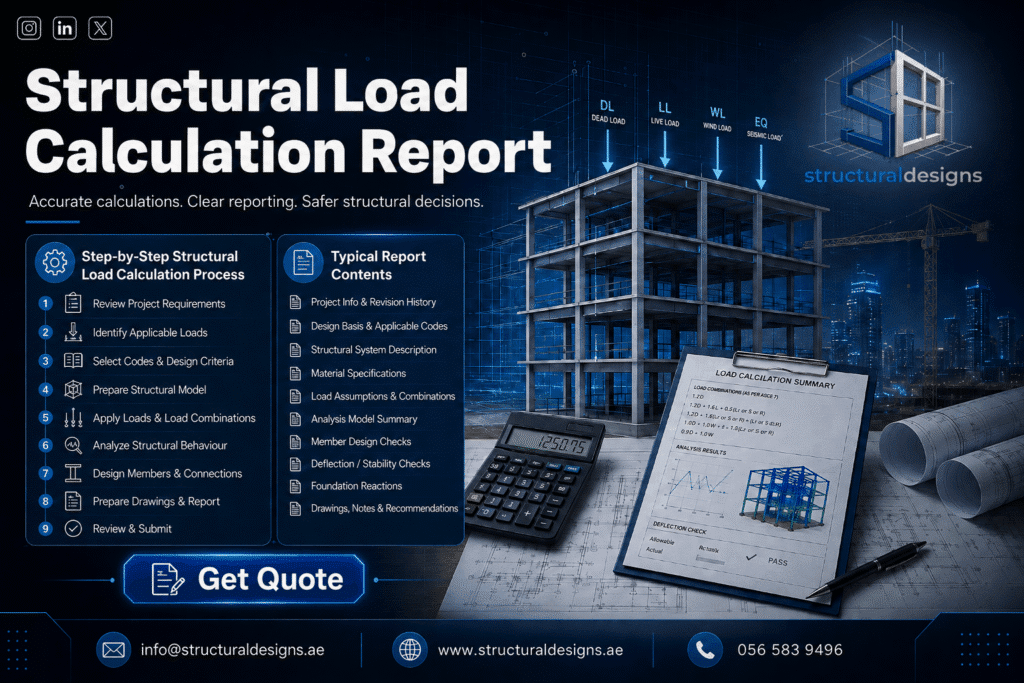
What Is a Structural Load Calculation Report?
A Structural Load Calculation Report is a technical engineering document that shows the design loads, load combinations, analysis assumptions, structural checks, member forces, material properties, design code references, and safety verification required to confirm whether a structure can safely support intended loads.
This report is commonly prepared by structural engineers for new buildings, steel platforms, mezzanine floors, warehouse racking supports, roof equipment supports, gantry structures, industrial sheds, villa modifications, façade supports, MEP supports, and temporary works.
The report usually supports structural drawings, authority submissions, contractor coordination, peer review, and construction decision-making. It should not be treated as a generic calculation sheet. A reliable report must clearly connect the project requirement, site condition, design code, structural model, analysis result, and final engineering recommendation.

Why Structural Load Calculations Matter
Structural load calculations help confirm whether a structure is safe, serviceable, durable, and suitable for its intended use.
In practical terms, they answer questions such as:
- Can the slab support the proposed machinery or storage load?
- Is the roof strong enough for HVAC units, solar panels, or access walkways?
- Will a steel platform remain stable under live loads and vibration?
- Are beams, columns, base plates, anchors, and foundations adequate?
- Does the proposed structural modification affect the existing building?
For warehouses and logistics facilities, load calculations are especially important because storage loads, forklift movement, pallet racking systems, mezzanine floors, and equipment loads can be significantly higher than ordinary building loads.
Dubai Municipality also states that its building permit procedures are designed to apply quality standards and approved specifications to ensure the safety of buildings and structures, including procedures for building permits, completion certificates, site inspections, soil test results, and industrial area topographic maps.
What a Structural Load Calculation Report Includes
A professional Structural Load Calculation Report should be clear enough for engineers, reviewers, contractors, and project stakeholders to understand the design logic.
Typical Report Contents
A well-prepared report may include:
- Project title, location, client, consultant, and revision history
- Design basis and applicable codes
- Structural system description
- Material specifications for concrete, steel, anchors, bolts, or masonry
- Dead load, live load, wind load, seismic load, equipment load, and imposed load assumptions
- Load combinations used for design
- Structural analysis model screenshots or summaries
- Design checks for beams, slabs, columns, frames, bracing, foundations, base plates, and connections
- Deflection, vibration, stability, and serviceability checks were required
- Foundation reactions and load transfer path
- Key structural drawings and references
- Engineering notes, limitations, and recommendations
For authority or developer review, the report should be consistent with the submitted drawings. In Dubai Development Authority areas, for example, substructure design approval documentation can include final structural design drawings, RC structural design review checklist, structural calculations, structural model, and peer review report, where applicable.
Step-by-Step Structural Load Calculation Process
1. Review Project Requirements
The engineer starts by reviewing architectural drawings, existing structural drawings, site data, equipment details, warehouse operation requirements, and client objectives. For existing structures, site inspection may also be required.
2. Identify Applicable Loads
The next step is to identify all relevant loads. These may include self-weight, finishes, partitions, occupancy loads, storage loads, machinery loads, crane loads, wind effects, seismic actions, thermal effects, and temporary construction loads.
3. Select Codes and Design Criteria
The design criteria depend on the project location, authority requirements, client specifications, and type of structure. UAE projects may refer to local building codes, authority guidelines, and internationally accepted design standards such as ASCE, ACI, AISC, Eurocodes, or British Standards, where applicable. Final code selection should always be verified by the appointed licensed consultant and relevant authority.
4. Prepare the Structural Model
The engineer develops a structural analysis model using software such as ETABS or STAAD.Pro, SAFE, SAP2000, Robot Structural Analysis, Tekla Structural Designer, or IDEA StatiCa, depending on the project scope.
5. Apply Loads and Load Combinations
Loads are applied to the model based on tributary areas, equipment data, occupancy category, wind exposure, support conditions, and structural layout. Load combinations are then used to check critical design conditions.
6. Analyze Structural Behaviour
The engineer reviews reactions, bending moments, shear forces, axial forces, torsion, drift, deflection, vibration, buckling, and stress distribution.
7. Design Members and Connections
Members are checked for strength and serviceability. For steel structures, this may include beams, columns, bracing, base plates, welds, bolts, and anchors. For RCC structures, this may include slabs, beams, columns, footings, punching shear, and reinforcement requirements.
8. Prepare Drawings and Report
The final calculation report should align with structural drawings, connection details, foundation layouts, general notes, and construction documentation.
9. Review and Submit
Before submission, the report should be checked internally by a qualified structural engineer. For selected projects, a third-party review or peer review may be required.
Common Projects That Require Load Calculation Reports
Structural load calculation reports are commonly required for:
- Warehouse mezzanine floors
- Industrial steel platforms
- Machine foundations
- Rooftop HVAC supports
- Solar panel support structures
- MEP pipe rack supports
- Crane runway beams
- Storage rack support checks
- Villa extensions and modifications
- Steel sheds and canopies
- Temporary access platforms
- Façade and architectural support systems
- Staircases, ladders, and access structures
- Existing building structural assessment
For warehouse and industrial projects in Abu Dhabi, official TAMM service listings include building permit services for new warehouse projects, showing that industrial and warehouse works often pass through formal permit channels depending on project type and location.
Local UAE Authority and Approval Considerations
Structural requirements can vary depending on whether the project is in Dubai, Abu Dhabi, Sharjah, Ajman, Ras Al Khaimah, Fujairah, or Umm Al Quwain. Free zones and master developers may also have their own submission requirements.
Dubai
Dubai projects may involve Dubai Municipality, Dubai Development Authority, Trakhees, Dubai Civil Defence, DEWA, or relevant master developer requirements. The Dubai Building Code aims to unify building design across Dubai and establish minimum requirements for safety, welfare, environmental impact, and sustainable development.
Abu Dhabi
Abu Dhabi projects may involve the Department of Municipalities and Transport, TAMM, Abu Dhabi Municipality, and related approval platforms. DMT also maintains classification requirements for firms applying for building permit services, including references to engineering firms, licensed engineers, and structural engineering exams.
Other Emirates
For Sharjah, Ajman, Ras Al Khaimah, Fujairah, and Umm Al Quwain, the structural consultant should verify the applicable municipality, civil defence, utility, industrial area, free zone, or developer submission requirements before finalizing the report.
Common Mistakes to Avoid
Many calculation reports fail not because the engineering concept is wrong, but because the documentation is incomplete or poorly coordinated.
Common mistakes include:
- Using generic load values without project-specific verification
- Missing equipment data or storage load information
- Ignoring existing structural capacity
- Not checking deflection or vibration
- Providing calculations that do not match drawings
- Missing connection design for steel structures
- Ignoring foundation reactions
- Submitting unclear software output without explanation
- Not considering future maintenance access or operational changes
- Assuming authority acceptance without checking local requirements
A good report should be transparent, traceable, and easy to review.
How to Choose the Right Structural Consultant in UAE
When selecting structural consultants in UAE, look for a team that understands both engineering design and local submission expectations.
Choose a consultant who can provide:
- Structural engineering experience in UAE projects
- Clear understanding of local authority requirements
- Structural analysis and structural drafting services in UAE
- RCC and steel structure design capability
- Proper software-based analysis and manual verification
- Authority-ready calculation reports and drawings
- Site inspection support where required
- Coordination with architects, MEP consultants, contractors, and facility managers
- Practical recommendations instead of overdesign
For commercial, industrial, warehouse, and logistics projects, the consultant should understand operational loads, equipment layouts, access loads, storage systems, forklift movement, future expansion, and construction sequencing.
Final Thoughts
A Structural Load Calculation Report is more than a technical formality. It is a key document that helps confirm whether a structure can safely support the loads it is expected to carry. For UAE projects, especially in Dubai, Abu Dhabi, Sharjah, Ajman, Ras Al Khaimah, Fujairah, and Umm Al Quwain, the report should be accurate, well-structured, coordinated with drawings, and aligned with applicable authority expectations.
If you need support with structural calculations, structural analysis, structural drafting services in UAE, or authority-ready engineering documentation, speak with a qualified structural consultant who can review your project requirements and guide you through the correct next steps.
FAQs
1. What is a Structural Load Calculation Report?
A Structural Load Calculation Report is an engineering document that shows the loads, assumptions, analysis results, design checks, and safety verification for a structure or structural element.
2. Who prepares structural load calculation reports in UAE?
Structural load calculation reports should be prepared or reviewed by qualified structural engineers or licensed engineering consultants familiar with UAE authority requirements.
3. When is a structural calculation report required?
It may be required for new buildings, warehouse modifications, mezzanine floors, steel structures, rooftop equipment supports, industrial platforms, structural alterations, and authority submissions.
4. What loads are considered in structural calculations?
Typical loads include dead load, live load, wind load, seismic load, equipment load, storage load, crane load, thermal load, and construction load, depending on project type.
5. Is a structural calculation report required for warehouse mezzanine floors?
Yes, mezzanine floors usually require structural calculations because they add new loads to the existing slab, columns, beams, foundations, or supporting structure.
6. Can an existing building be checked using load calculations?
Yes. Engineers can review existing drawings, inspect the site, assess material conditions, and calculate whether the structure can support proposed additional loads.
7. What software is used for structural analysis?
Common tools include ETABS and STAAD.Pro, SAFE, SAP2000, Robot Structural Analysis, Tekla Structural Designer, and IDEA StatiCa, depending on the project scope.
8. Does the report guarantee authority approval?
No responsible consultant should guarantee approval. A strong report improves review quality, but final approval depends on authority requirements, project conditions, and reviewer comments.
9. What documents are usually needed with the report?
Typical documents include architectural drawings, structural drawings, equipment details, load data, soil report, existing drawings, site photos, and authority or developer requirements.
10. How do I choose structural consultants in UAE?
Choose consultants with UAE project experience, structural analysis capability, drafting support, authority submission knowledge, clear communication, and a practical approach to safety and cost control.