Structural Approvals Dubai are required when a project involves new construction, structural modification, load changes, slab openings, mezzanines, warehouses, industrial facilities, or any work that may affect building safety. For contractors, facility managers, logistics companies and industrial property owners, the approval process is not only paperwork. It confirms that the proposed work has been reviewed against applicable structural engineering, safety, and authority requirements.
Dubai Municipality states that building permit procedures are intended to ensure building and structural safety, approved specifications, technical inspections and completion certificates. The same page separates procedures for residential villas, industrial buildings, multi-storey buildings and public buildings, which shows why project type matters from the beginning.
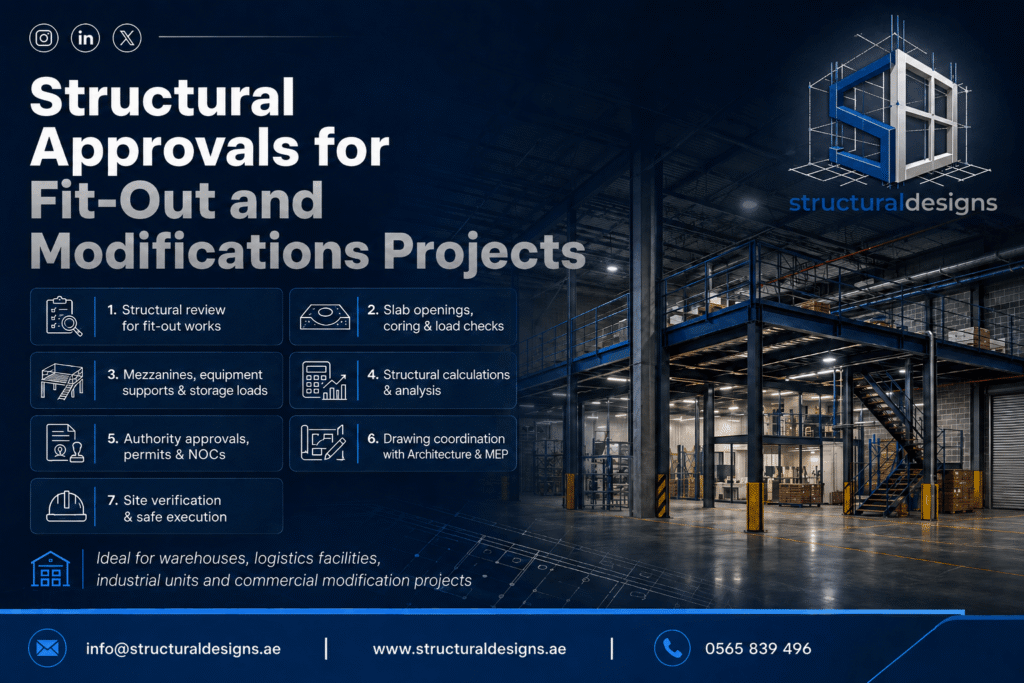
What Are Structural Approvals Dubai?
Structural approvals are official authority reviews of structural drawings, structural calculations, analysis models, material specifications and supporting documents before construction or modification work begins. They help confirm that the design is safe, code-compliant, coordinated with other disciplines and suitable for the proposed building use.
In Dubai, the applicable authority depends on the project location and jurisdiction. Projects may fall under the Dubai Municipality, Dubai Development Authority, Trakhees, free zone authorities, master developers or other competent entities. The Dubai Building Code aims to unify building design across Dubai and clearly mandate minimum requirements related to health, safety, welfare, environmental impact and sustainability.
Why Structural Authority Approval Matters
Structural authority approval protects the owner, contractor, tenants and the public. It verifies the load path, stability, serviceability, fire and life safety coordination, and constructability before work starts.
For warehouses and logistics facilities, this is especially important because changes often involve heavy storage loads, racking systems, forklifts, mezzanine floors, dock levellers, HVAC equipment, water tanks, roof-mounted services or slab coring. A small drawing change can create a serious structural issue if the existing slab, beam, column, foundation or connection capacity is not verified.
Authority approval also helps avoid:
- Unauthorized site work,
- Rework after inspection comments,
- Delays in the completion certificate,
- Tenant handover issues,
- Insurance or compliance problems,
- Unsafe loading of existing buildings.
Key Documents Required for Structural Approvals in Dubai
The exact document list depends on the authority and project type, but a typical structural submission may include:
- Structural drawings,
- Architectural drawings for coordination,
- Structural calculations,
- Structural analysis model, if required,
- Design basis report,
- Material specifications,
- Existing approved drawings,
- As-built drawings or site survey,
- Soil investigation report for foundations,
- Method statement,
- Risk assessment,
- NOC from owner, landlord, or master developer,
- Contractor and consultant appointment letters,
- Authority forms and checklists.
Dubai Development Authority’s Final Design Approval service specifically refers to approval of architectural, structure and mechanical design before the building permit, and lists structural design drawings, RC structural design approval checklist, structural calculations and structural model as part of the required submission where applicable.
Step-by-Step Structural Approval Process
1. Confirm the authority jurisdiction
The first step is to confirm whether the property falls under Dubai Municipality, DDA, Trakhees, a free zone, a master developer, or another competent authority. This affects the portal, forms, fees, drawing standards and review route.
2. Review existing documents
The consultant should review approved drawings, as-built drawings, previous completion certificates, lease drawings, structural framing plans, slab details, foundation information and any earlier modification approvals.
3. Conduct site verification
For existing buildings, site verification is critical. The engineer may check slab thickness, beam sizes, column locations, cracks, corrosion, deflection, previous openings, unauthorized supports, water leakage and actual equipment locations. Text or photos alone should not be treated as final proof of structural safety.
4. Prepare structural design and calculations
The structural consultant prepares the design basis, load assumptions, structural analysis, member checks, connection details, deflection checks and load transfer explanation. Loads may include dead load, live load, finishes, partitions, storage, racking, equipment, water tanks, façade loads, wind and seismic considerations where relevant.
5. Coordinate with architecture and MEP
Many authority comments happen because structural drawings do not match architectural, fire, MEP or fit-out layouts. Before submission, openings, risers, sleeves, equipment supports, staircases, façade supports and drainage penetrations should be coordinated.
6. Submit through the authority portal
Submission is usually handled by an approved consultant or contractor through the relevant online portal. DDA’s Final Building Permit service, for example, enables the contractor to obtain the building permit and start construction work, with online submission, document upload, fee payment and feedback stages.
7. Respond to authority comments
Authority reviewers may request clarification, revised drawings, additional calculations, peer review, NOCs, material details, inspection records or confirmation that the existing structure can support proposed loads.
8. Obtain permit before work starts
Construction, coring, strengthening, demolition, mezzanine installation or load changes should not proceed until the relevant permit or approval is issued.
9. Complete inspections and close-out
After work completion, the consultant and contractor may need to submit completion documents, as-built drawings, test reports, inspection records and authority close-out requirements.
Structural Approval for Fit-Out and Modifications
Fit-out projects often look simple but may still require structural review. This is common for slab openings, staircase openings, raised platforms, heavy equipment, kitchen exhaust supports, storage racks, chilled water units, signage frames or façade brackets.
In DDA-regulated projects, the Fit-Out Permit service allows contractors to obtain permission to start fit-out works and then submit for completion. DDA notes that coring less than 200 mm should have no impact on structural elements such as tendons and should be at least 1 m away from the column; adding structural elements, changing use or additional GFA may require a Building Modification request.
This is a useful example of why structural consultants in UAE should review even small penetrations. Post-tensioned slabs, transfer beams and concealed reinforcement can be damaged if coring is done without scanning, drawings and engineering approval.
Common Reasons for Structural Approval Rejection
Authorities may reject or comment on submissions for practical reasons, including:
- Missing structural calculations,
- Uncoordinated architectural and structural drawings,
- Unclear load assumptions,
- Missing existing building information,
- Unsupported equipment or storage loads,
- Unsafe slab openings,
- Incomplete NOCs,
- Wrong authority jurisdiction,
- Lack of approved consultant or contractor details,
- Missing method statement for modification works,
- Unclear structural strengthening details.
A strong submission explains not only what is proposed, but how loads are transferred safely to existing beams, columns, walls and foundations.
Local Considerations for Dubai and UAE Projects
Dubai projects may be reviewed under Dubai Municipality, DDA, Trakhees or other authorities, depending on the project area. Trakhees publishes Building Regulations and Design Guidelines for Structural works, intended to provide minimum structural design requirements and support review of structural schemes by designers, geotechnical engineers, specialist contractors and inspectors.
For companies working across Dubai, Sharjah, Ajman, Abu Dhabi, Ras Al Khaimah, Fujairah and Umm Al Quwain, the technical principle remains the same: confirm the authority, verify the existing structure, prepare proper calculations, coordinate drawings and obtain approval before construction. However, portals, forms, review timelines and document requirements can vary.
How to Choose Structural Consultants in the UAE
Choose a structural consultant who understands both engineering design and authority approval. The right consultant should be able to:
- Review existing drawings and site conditions,
- Prepare structural calculations clearly,
- Model the structure where required,
- Coordinate with the architect, MEP, and contractor,
- Identify authority requirements early,
- Respond to technical comments professionally,
- Advise when testing or scanning is required,
- Avoid unnecessary structural elements while maintaining safety.
For warehouses and industrial structures, also check experience with racking loads, mezzanine systems, equipment foundations, steel platforms, canopies, dock areas, fire coordination, and operational constraints.
Planning Factors: Cost, Timeline and Coordination
Approval cost and timeline depend on project size, authority, drawing readiness, consultant registration, number of comments, site condition, availability of existing drawings and whether third-party review is required. Avoid relying on generic timelines without checking the latest authority portal.
The best way to reduce delay is to prepare a clean submission from the start. That means correct title blocks, matching drawings, realistic loading, clear structural analysis, signed documents, valid NOCs and early coordination with fire, MEP and architectural teams.
Final Thoughts
Structural Approvals Dubai are an essential part of safe and compliant construction, fit-out and modification works. A good approval package should clearly explain the proposed work, structural design basis, load assumptions, analysis results, drawings, method of construction and limitations.
If your project involves a warehouse, industrial facility, logistics unit, commercial fit-out, slab opening, mezzanine, equipment support or structural modification, speak with a qualified structural engineering consultant before starting work. Proper review, structural calculations and authority coordination can prevent delays, rework and unsafe construction.
FAQs
1. What are Structural Approvals Dubai?
Structural approvals are authority reviews of structural drawings, calculations and supporting documents before construction or modification work starts.
2. Who can submit structural approval documents in Dubai?
Usually, submissions must be made by an approved or registered consultant or contractor through the relevant authority portal.
3. Do warehouse racking systems need structural approval?
They may require approval if they affect slab loading, fire access, storage height, floor capacity, anchoring or operational safety. A structural review is recommended.
4. Is approval required for slab coring?
Yes, approval or NOC is often required, especially if coring may affect reinforcement, post-tension tendons, beams, columns or services.
5. What documents are needed for structural calculations?
Typical inputs include drawings, member sizes, slab thickness, material grades, load data, proposed layout, soil data and existing capacity information.
6. Do fit-out works need structural approval?
Fit-out work may need structural approval if it includes openings, heavy equipment, mezzanines, structural supports, a change of use or additional loads.
7. Can construction start before authority approval?
No. Work affecting structure or safety should start only after obtaining the required permit, NOC or authority approval.
8. What causes approval delays?
Common causes include incomplete drawings, missing calculations, wrong jurisdiction, unclear load assumptions, missing NOCs and poor coordination.
9. Are Dubai approvals valid across all UAE emirates?
No. Each emirate or authority has its own approval process. Dubai approvals do not automatically replace Sharjah, Abu Dhabi or other emirate requirements.
10. Do structural consultants also handle authority comments?
Yes, experienced structural consultants usually revise drawings, clarify calculations and respond to authority technical comments.