Structural analysis services in UAE help contractors, facility managers, warehouse owners, logistics companies, and industrial project teams understand whether a structure can safely resist the loads and conditions it will face during its service life. From villas and warehouses to steel platforms, MEP supports, foundations, canopies, and industrial structures, proper structural analysis reduces design risk, improves constructability, and supports authority submission requirements.
In Dubai and other Emirates, structural decisions should be based on verified calculations, approved drawings, applicable codes, and project-specific site conditions. Dubai Municipality states that the Dubai Building Code was created to unify building design and clearly define minimum requirements, while its permit procedures are linked to safety, approved specifications, inspections, soil test results, and completion certificates.
What Are Structural Analysis Services in UAE?
Structural analysis is the engineering process of checking how a building, steel structure, foundation, support frame, or civil structure behaves under loads such as dead load, live load, wind, equipment load, seismic effects, vibration, and temperature movement.
Structural analysis services usually include load assessment, structural modelling, member design checks, stability verification, connection review, foundation reactions, deflection checks, and preparation of structural calculations. These services are closely linked with structural engineering, structural design and drafting, BIM modeling, and authority approval drawings.
For example, a warehouse mezzanine may require analysis for storage loads, forklift movement, column reactions, steel beam sizing, slab capacity, and connection safety. A rooftop MEP support frame may require checks for wind load, equipment vibration, waterproofing coordination, and load transfer to the existing roof structure.
Why Structural Analysis Matters for Buildings and Industrial Projects
Structural analysis is important because it helps confirm that a structure is safe, stable, serviceable, and suitable for its intended use. It is not only about preventing failure. It also helps avoid excessive deflection, cracking, vibration, overdesign, material wastage, approval delays, and site modification costs.
For contractors, proper analysis supports clear construction drawings and reduces uncertainty during execution. For facility management teams, it helps assess whether an existing building can accept new loads, equipment, platforms, solar systems, signage, or façade elements. For logistics and warehouse operators, it helps protect operations where racks, mezzanines, docks, cranes, and heavy equipment can create concentrated loads.
Dubai’s legal framework also highlights that the structural design of buildings and structures must be prepared by a qualified licensed structural engineer under applicable legislation.
Key Elements of Structural Analysis
Load Assessment
Every structural analysis starts with defining realistic loads. These may include:
- Self-weight of structural members
- Floor live loads
- Storage and racking loads
- Wind loads
- Seismic loads where applicable
- Equipment and machinery loads
- Crane, hoist, or dynamic loads
- Façade, signage, canopy, and MEP loads
International references such as ASCE 7 provide methods for determining design loads for buildings and other structures, while ACI 318 covers minimum requirements for structural concrete materials, design, and detailing.
Structural Modelling
Engineers use structural models to study how loads move through beams, columns, slabs, walls, bracing systems, foundations, and connections. For complex projects, 3D analysis models help identify weak points, load paths, lateral stability issues, and coordination conflicts before construction.
Member and Connection Checks
Analysis should verify whether beams, columns, slabs, foundations, base plates, anchors, welds, bolts, and bracing elements are suitable. For steel structures, connection design is especially important because many failures begin at joints rather than main members.
Deflection and Serviceability
A structure may be strong enough but still perform poorly if it deflects, vibrates, cracks, or moves beyond acceptable limits. This is particularly important for facades, glass supports, equipment platforms, long-span roofs, staircases, and canopies.
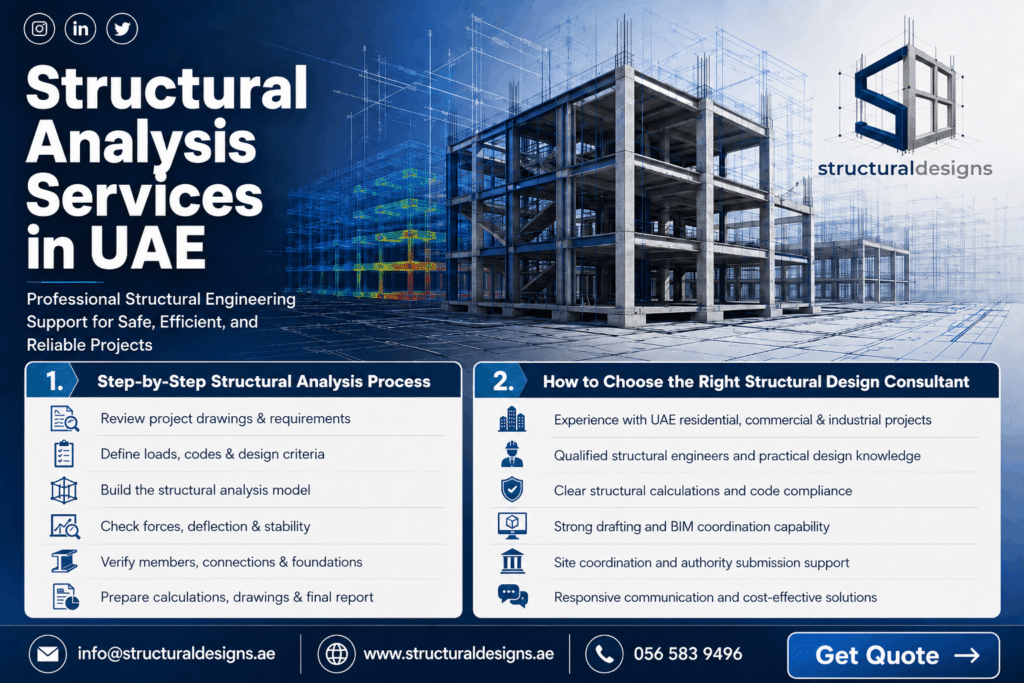
Step-by-Step Structural Analysis Process
- Review project information
The engineer studies architectural drawings, site constraints, existing structural details, soil reports, equipment data, and client requirements. - Identify applicable codes and authority requirements
The design basis should match local authority expectations and relevant structural standards. Abu Dhabi’s building code framework, for example, was developed to safeguard public health and safety through building regulations. - Define loads and load combinations
Loads are selected based on use, location, material, exposure, occupancy, and project function. - Prepare the structural model
Engineers create 2D or 3D models using appropriate structural analysis software. - Analyze structural behavior
The model is checked for forces, moments, reactions, stability, deflection, and load path performance. - Design or verify members
RCC, steel, timber, aluminum, or composite members are checked based on project requirements. - Prepare structural calculations and reports
A clear report should explain assumptions, codes, inputs, results, member checks, and recommendations. - Coordinate drawings and BIM models
Structural drafting services in UAE often work alongside BIM modeling to improve coordination with architectural and MEP teams. - Support authority or consultant review
Final submissions should be reviewed and signed by the responsible qualified professional where required.
Common Mistakes to Avoid
- One common mistake is relying on generic member sizes without checking actual loads. This can lead to unsafe design or unnecessary material cost.
- Another mistake is ignoring existing structure limitations. For renovations, warehouses, rooftop equipment, and industrial modifications, the existing slab, beams, columns, and foundations must be checked before adding new loads.
- Poor coordination is also a frequent issue. A structural frame may be technically correct but difficult to construct if it clashes with MEP services, access routes, façade systems, or architectural requirements.
- Incomplete calculation reports can delay reviews. A good structural calculations package should clearly show design assumptions, codes used, load cases, analysis results, member checks, and drawings linked to the calculation output.
Local Considerations Across the UAE
- Structural analysis services in UAE should consider local project conditions, authority expectations, and construction practices in Dubai, Sharjah, Ajman, Abu Dhabi, Ras Al Khaimah, Fujairah, and Umm Al Quwain.
- In Dubai, Dubai Municipality building permit procedures are connected with building permits, completion certificates, approved specifications, technical inspections, soil test results, and topographic information for certain industrial areas.
- In Abu Dhabi, the Department of Municipalities and Transport provides building-related services, and the Abu Dhabi building code framework is an important reference for projects under that jurisdiction.
- For industrial and logistics projects, engineers should also consider heavy operational loads, high clear heights, racking systems, equipment foundations, loading bays, thermal movement, corrosion exposure, and future expansion.
How to Choose the Right Structural Design Consultant
Choose structural design consultants who can combine technical analysis with practical drafting, authority documentation, and site coordination. A reliable consultant should provide:
- Clear design basis and calculation reports
- Experience with RCC, steel, foundations, and industrial structures
- Structural drafting and construction drawing support
- BIM coordination where required
- Understanding of local UAE authority expectations
- Practical site supervision support
- Transparent communication with contractors and clients
The Society of Engineers UAE describes its role in accrediting engineering certifications, regulating professional practices, and developing engineering qualifications, which supports the importance of professional competence in engineering services.
Final Thoughts
- Structural analysis services in UAE are essential for safe, efficient, and approval-ready projects. Whether the requirement is a warehouse steel structure, rooftop equipment support, industrial platform, villa modification, foundation design, or structural calculations report, proper analysis helps reduce risk and improve construction quality.
- For any project involving structural changes, new loads, authority submissions, or construction drawings, speak with a qualified structural engineer or approved consultant who can review the project requirements and guide the next steps professionally.
FAQs
1. What are structural analysis services in UAE?
Structural analysis services in UAE involve checking how a structure behaves under loads such as wind, live load, equipment load, dead load, and seismic effects. The service usually includes modelling, calculations, member checks, and engineering reports.
2. Who needs structural analysis services?
Building contractors, warehouse owners, logistics companies, industrial facilities, developers, facility management teams, and fit-out contractors often need structural analysis before construction, modification, or authority submission.
3. Is structural analysis required for warehouse projects?
Yes, warehouse projects often require structural analysis because racking systems, mezzanines, forklifts, loading docks, and storage loads can significantly affect slabs, columns, foundations, and steel members.
4. What is included in a structural calculations report?
A structural calculations report usually includes design assumptions, load cases, codes used, material properties, analysis results, member design checks, reactions, deflection checks, and engineering recommendations.
5. Can structural analysis be done for existing buildings?
Yes. Existing buildings can be analyzed for modifications, added equipment, rooftop supports, mezzanines, solar panels, façade systems, signage, or a change of use. Site verification and existing drawings are usually required.
6. What is the difference between structural design and structural analysis?
Structural analysis checks how a structure responds to loads. Structural design uses that analysis to size members, connections, foundations, and details so the structure can safely perform as required.
7. Are BIM models useful for structural analysis?
BIM models help improve coordination between structural, architectural, and MEP teams. They are especially useful for complex buildings, industrial structures, steel framing, and projects where clash detection is important.
8. Which UAE locations need structural analysis services?
Structural analysis services are commonly required in Dubai, Abu Dhabi, Sharjah, Ajman, Ras Al Khaimah, Fujairah, and Umm Al Quwain for residential, commercial, industrial, and infrastructure-related projects.
9. How long does structural analysis take?
The timeline depends on project size, available drawings, complexity, site data, and review requirements. A small support frame may take less time than a full building, industrial platform, or existing structure assessment.
10. Should final structural decisions be verified by a licensed engineer?
Yes. Final structural decisions, drawings, calculations, and authority submissions should be reviewed and verified by a qualified structural engineer or approved consultant according to the relevant project jurisdiction.